BIOL 1101 Windsor Buffering Capacity of A Phosphate Buffer Biology Lab Questions
Question Description
*Lab is not needed to complete this assignment* You are simply making notes based on facts as in what will happen in the situations. Answer all questions and make notes for all statements.
Background
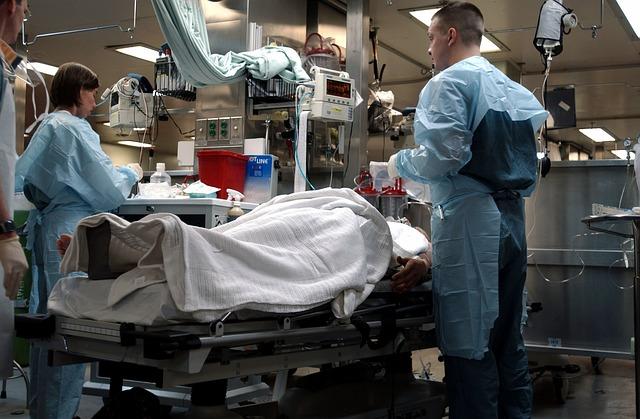
Figure 1. Doctors Helping a Patient
I Need an Amp of Bicarb!
You may have heard actors portraying emergency-department physicians shout this on television. When a patient is in cardiac arrest, the heart stops beating, and acid tends to accumulate in the body, throwing off the acidbase balance. In humans, only a narrow range of pH is compatible with life. Acidosis, or low pH, can cause complications in getting the heart of a patient restarted after cardiac arrest.
The bicarb is actually sodium bicarbonate (NaHCO3), which dissociates into Na+ and HCO3. In the presence of excess acid in the body, HCO3 can react with the extra H+, turning first into H2CO3, and then finally to CO2 and H2O. Although recent studies have mixed results about the utility of administering sodium bicarbonate to patients in cardiac arrest, no study has found that it is detrimental. Therefore, it is still a common practice in many emergency departments (Figure 1). Buffers are solutions that maintain a steady pH. Buffers are found in your body and are also used in science to control the pH of solutions. Before you can understand how these buffers function, it is important that you have a basic understanding of the chemistry of components that make up a buffer.
Acids, Bases, and pH Buffers
An aqueous, or water-based, solution is a liquid in which water is the solvent and other chemicals are dissolved in it. All life on Earth is based on aqueous solutions. Blood, intracellular fluid, and extracellular fluid are all aqueous solutions of different substances. Some of these solutions also contain cells.
Water, as a chemical substance, actually exists in two forms. You are likely familiar with H2O, but it also comes as the positive ion H3O+ (hydronium) and as the negative ion OH (hydroxide). The process of splitting molecules into ions is called dissociation. In a glass of water, a very small number of the water molecules are in the ionic form, just 1 in every 10 million (107) molecules.
This natural concentration of ions is both important and measurable. It is the basis of aqueous acidbase chemistry. The concentration of H3O+ and OH ions in pure water is 10-7 mol/L. The pH scale is defined as the negative logarithm (base 10) of the H3O+ concentration.
|
|
Acids and bases are chemicals that dissolve in water and dissociate into their constituent ions. Although there are different definitions of acids and bases, the BrønstedLowry definition is commonly used. A BrønstedLowry acid is defined as a chemical species that can donate (lose) a proton (H+), and a BrønstedLowry base is a chemical species that can accept (gain) a proton. The hydrogen ion (H+) is highly reactive and it reacts with water to form the hydronium ion (H3O+). Strong acids and bases completely dissociate into their constituent ions when dissolved in water, whereas weak acids and weak bases only slightly dissociate into ions.
The conjugate base of an acid is the form of the acid after it loses a proton. The conjugate acid of a base is the form of the base after it gains a proton. In solution, the acid, base, and their conjugates exist in equilibrium as shown below.
The pH scale ranges from 0 to 14. Pure water is neutral with a pH of 7. Solutions with a pH lower than 7 are acidic and solutions with a pH greater than 7 are basic. The lower the pH, the more acidic a solution is. The higher the pH, the more basic a solution is.
Said a different way, if the concentration of hydronium ions (H3O+) in an aqueous solution is increased above its concentration for pure water, the solution is acidic. If the concentration of hydronium ions in an aqueous solution is decreased below its concentration for pure water, then the solution is basic.
For example, consider a 1.0 M hydrochloric acid (HCl) solution. This is a solution of HCl dissolved in water with a concentration of 1 mole HCl per 1 liter of solution. HCl is a strong acid whose molecules totally dissociate into H+ and Cl ions. Therefore, the hydronium ion (H3O+) concentration is 1 mol/L. This gives a pH of 0.
Most other acids are weak, which means that only a fraction of the molecules are dissociated into H+ and A ions at any one time. Acetic acid is an example of a weak acid. The pH of a 1 M acetic acid solution is 2.38.
Buffers
Small changes in pH can alter the function of important biological molecules such as enzymes. For this reason, the pH in most organisms is tightly regulated. The pH of human blood is slightly basic at 7.4. Generally, the pH of human blood must stay between 6.8 and 7.8 to sustain life.
The pH of a solution can be kept stable with the use of buffers. A buffer is a solution that is resistant to pH changes upon the small additions of acid or base. Buffers consist of a weak conjugate acidbase pair. Therefore, a buffer can be either a weak acid and its conjugate base, or a weak base and its conjugate acid.
The most common buffer systems are those with a weak acid and its conjugate base. In this case, the conjugate base will neutralize added acids and the weak acid will neutralize added bases. Because the conjugate base can neutralize added acids and the weak acid can neutralize added bases, the pH of a buffered solution is maintained at a nearly constant value until one of the buffer components is completely used up.
Even when a strong acid is added to the buffer, the amount of free H+ ions in the solution remains relatively constant as long as there is enough conjugate base to neutralize it.
Two buffers that occur naturally in living organisms are carbonate and phosphate buffers. . The carbonate system is useful for buffering the carbonic acid formed by dissolved carbon dioxide (CO2). Carbonic acid (H2CO3) actually dissociates twice, adding two hydrogen ions to the solution.
The carbonate buffer system is useful for preventing large changes in blood pH due to the presence of acids, but it does not function well in maintaining the physiological pH of 7.4. In the human body, kidney function and pulmonary gas exchange are equally important in maintaining the pH of the blood.
The phosphate buffer system is found in large concentration in intracellular fluid and in the kidneys, where it prevents large fluctuations in pH in response to acids or bases.
Buffer Capacity
Buffer capacity is defined as the amount of protons (acid) or hydroxide ions (base) a buffered solution can absorb without undergoing a significant change in pH. You can quantitatively test the buffering capacity of a weak acidconjugate base buffer by adding acid or base and observing the change in pH. Buffer capacity is dependent on the amount of conjugate acidbase pairs in relation to added acid or base. In weak acidconjugate base buffers, the amount of strong acid that can be added without drastically changing the pH of the solution is roughly equal to the amount of conjugate base in the buffer. The amount of strong base that can be added without drastically changing the pH is roughly equal to the amount of weak acid in the buffer.
For example, phosphate buffer has a pH of approximately 7. It contains two different chemical components NaH2PO4 and Na2HPO4. The phosphate buffer you will use contains 2.5 mL of a 0.1 molar solution of each salt. . Na2HPO4, readily dissociates into Na+ and HPO42. The HPO42 neutralizes protons (H+), and is the conjugate base in this solution. NaH2PO4 readily dissociates into Na+ and H2PO4. H2PO4 is the weak acid, and it neutralizes bases.
To estimate the buffering capacity of this solution in response to the addition of a strong acid, you must first determine how much of the conjugate base is present in the solution. Remember that the conjugate base is what absorbs the protons from the strong acid.
A concentration of 0.1 M means a concentration of 0.1 moles per liter of solution. Convert this to mmol of Na2HPO4 as follows.
|
|
Therefore, 0.25 mmol of Na2HPO4 is present. This means that there will be 0.25 mmol of HPO42 in solution. The same volume and concentration of NaH2PO4 is present. This compound absorbs hydroxide ions, acting as a sponge for added bases. Calculate the amount of NaH2PO4 and the weak acid it forms the same way you calculated the amount of Na2HPO4.
You will be adding acid or base to the phosphate buffer solution in a drop-wise manner. One drop is approximately 0.05 mL, and the concentrations of both the strong acid and the strong base are 0.5 M. You can calculate the amount of acid or base added (in mmol/drop) as follows.
Given that the buffer’s capacity is 0.25 mmol, and the concentration of acid or base is 0.025 mmol/drop, we can hypothesize that the phosphate buffer will absorb up to 10 drops ((0.25 mmol)/(0.025 mmol/drop)).
pH Indicators
pH indicators are substances used to assist in determining the pH of a sample. In most cases, pH indicators change color over a particular range of pH. For example, phenol red changes from red in basic solutions to yellow in acidic solutions. Some pH indicators are supplied as a coated test strip. Dropping some of your sample onto the test strip, then comparing the colors on the test strip with a standard allows you to determine the pH. In general, indicators provide a colorimetric estimate of the pH (Figure 2).

Figure 2. Examples of pH Indicators
Although some indicators change color every 0.5 pH units, a properly calibrated pH meter is still more accurate. Most pH meters have two basic parts, a probe and the meter. The probe gets inserted into the solution, whereas the meter reports the pH. A pH meter determines pH by measuring the voltage of a solution and comparing it with a known standard. The difference in voltage of these two solutions is what the pH meter uses to determine the pH.
For this reason, the pH meter must be calibrated before each use. Calibration involves placing the probe into a solution of known pH and then adjusting the meter so that it reads the appropriate pH. After this, the pH meter can be used to determine the pH of a sample.
About This Lab
In this lab, you will conduct three experiments. First, you will use an indicator to determine the pH of various solutions. The indicator bromothymol blue derives from the herb thyme and changes color depending on the pH of the solution. Second, you will determine which of four different solutions is the best buffer against pH changes upon the addition of acid or base. Finally, you will examine the ability of phosphate buffer to buffer against pH changes upon the addition of an acid or a base.
Experiments
Open the simulation by clicking on the virtual lab icon below. The simulation will launch in a new window.
You may need to move or resize the window in order to view both the Procedure and the simulation at the same time.
Follow the instructions in the Procedure to complete each part of the simulation. When instructed to record your observations, record data, or complete calculations, record them for your own records in order to use them later to complete the post-lab assignment.
Procedures
Experiment 1: Introduction to pH Indicators
- Take six small test tubes from the Containers shelf and place them onto the workbench.
- Label the test tubes 1 6 and add a reagent to each test tube according to the table below. All reagents can be found on the Materials shelf. Record the contents of each test tube for reference later.
|
Test Tube Number |
Solution |
|
1 |
10 mL water |
|
2 |
10 mL acetone |
|
3 |
10 mL 5 M citric acid |
|
4 |
10 mL 5% vinegar |
|
5 |
10 mL 4 M ammonia |
|
6 |
10 mL diluted bleach |
- Take a pH meter from the Instruments shelf and place it in the first test tube. To properly attach the meter, remember to place your cursor over the test tube when dropping the pH meter onto it. Repeat this procedure for test tubes 2 6. Record the color and pH of all six solutions to reference later.
- Take a 50 mL beaker from the Containers shelf and place it onto the workbench.
- Add 5 mL of bromothymol blue to the beaker.
- Take a dropper from the container shelf and place it on the workbench.
- Place the dropper into the beaker of bromothymol blue. You should observe the dropper filling with the liquid.
- Using the dropper, add 2 drops of bromothymol blue fto each test tube. Record the color and pH of all six solutions again after adding this material. Record your answers to the following:
- How accurate of an indicator is the bromothymol blue?
- Does it change to a different color for every pH examined?
- Does the addition of indicator change the pH of the solutions at all?
- Clear your workbench by dragging instruments back to the Instruments shelf and by emptying containers in the waste bin and then placing the empty containers in the sink.
Experiment 2: The Phosphate Buffer System
Part 1: Set-up
- Take four small test tubes from the Containers shelf and place them onto one side of the workbench.
- Label the test tubes 1 4 and fill the test tubes with solutions from the Materials shelf, according to the table below.
Note: The combination of the two phosphate solutions in the fourth test tube is the standard phosphate buffer.
Read the labels of the solutions on the shelf carefully, so you do not confuse the two phosphate solutions. Sodium hydrogen phosphate (Na2HPO4) and sodium dihydrogen phosphate (NaH2PO4) are not the same thing.
Test Tube Set-up
Test Tube Number
Water
0.1 M Sodium Dihydrogen Phosphate
0.1 M Sodium Hydrogen Phosphate
1
5 mL
2
5 mL
3
5 mL
4
2.5 mL
2.5 mL
|
Test Tube Set-up |
|||
|
Test Tube Number |
Water |
0.1 M Sodium Dihydrogen Phosphate |
0.1 M Sodium Hydrogen Phosphate |
|
1 |
5 mL |
||
|
2 |
5 mL |
||
|
3 |
5 mL |
||
|
4 |
2.5 mL |
2.5 mL |
|


