Benchmark: Human Experience
Benchmark: Human Experience
Benchmark: Human Experience
Permalink: https://collepals.com/benchmark-human-…llness-continuum/
Benchmark – Human Experience Across the Health-Illness Continuum
The benchmark assesses the following competency:
Benchmark: 5.1. Understand the human experience across the health-illness continuum.
Research the health-illness continuum and its relevance to patient care. In a 750-1,000 word paper, discuss the relevance of the continuum to patient care and present a perspective of your current state of health in relation to the wellness spectrum. Include the following:
Examine the health-illness continuum and discuss why this perspective is important to consider in relation to health and the human experience when caring for patients.
Reflect on your overall state of health. Discuss what behaviors support or detract from your health and well-being. Explain where you currently fall on the health-illness continuum.
Discuss the options and resources available to you to help you move toward wellness on the health-illness spectrum. Describe how these would assist in moving you toward wellness (managing a chronic disease, recovering from an illness, self-actualization, etc.).
Prepare this assignment according to the guidelines found in the APA Style Guide. An abstract or thesis is required.
Understanding the Human Health-Illness Continuum
A unified approach to the human health-illness continuum
This blog was written with Mariafe Panizo.
Recently my brother, a well-respected fitness trainer, asked me whether or not I considered obesity a disease, as it was declared a disease by the American Medical Association in 2013. I told him it was a complicated question, but I thought the unified theory could hold the debate that the experts were having about it. I told him that certainly obesity, like most complicated conditions, was clearly a “health-related issue” broadly defined, and I also said it should not be reduced to biology (which the word disease often implies), but rather should be thought of first as being on the continuum of human health-illness. A concern I have is that when medical doctors are the primary ones making the characterization, biological emphases become the trend (see here) and psychological and social considerations of health are minimized. If there is any doubt about this, consider this article, which describes psychiatry’s struggles with the fact that individual and family psychotherapy tends to help with schizophrenia. Why does much (but thankfully not all) of psychiatry struggle with this? As described in the article, the reason is that, unfortunately, much of psychiatry is committed to a misguided biologically reductive mindset. That said, it remained the case that telling my brother to check out the debates and to be wary of biological reductionism did not really answer his question, so I decided to develop a clearer map of the human-health illness dimension and apply it to obesity.
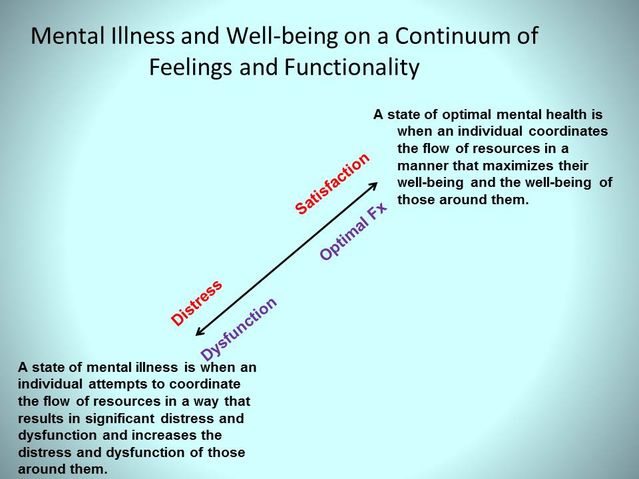
The first thing to do in building a map of the human health-illness continuum is to recognize that, broadly speaking, we can place the dimension of human health-illness on a continuum that consists of two related dimensions. The first is the dimension of subjective distress (i.e., generally speaking suffering versus happiness/satisfaction) and the second is degree of dysfunction. Here is a basic schematic of the health-illness continuum.
The second thing is to realize that there are four related, but separable dimensions of complexity: 1) the material/physical; 2) the organic/biological; 3) the mental/psychological; and 4) the human social/cultural. The traditional biopsychosocial model of human health gets that there are different levels in nature (i.e., atoms, cells, organ systems, individuals, groups), but fails to appreciate that nature also consists of dimensions of complexity mediated by different systems of information. I recently reviewed the traditional biopsychosocial model and its limitations and then explained why the ToK System is an advance.
article continues after advertisement
The third thing is to realize, as Jerry Wakefield has deeply explored, the health-illness construct involves a subjective and cultural value dimension and any conception of human health-illness must consider this fact. I will spare the reader details regarding the complex relation between facts and values when considering the human health-illness continuum. Instead, I will simply note that the unified approach offers the Nested Model of Human Well-being, depicted below, to bring clarity to the different domains that are operative when considering health-illness continuum.

The Nested Model posits that human well-being can be considered as the extent to which these domains are positively aligned. That is, individuals are high in well-being (and low in illness pathology) to the extent that they experience a predominance of positive relative to negative affective states (domain 1a) and are reflectively satisfied with their lives (domain 1b); are functioning well at the biological (domain 2a) and psychological (domain 2b) levels, and are in a material (domain 3a) and social (domain 3b) environments that are conducive to optimal functioning; and, finally, are living their lives in accordance with “the good” (domain 4; ideologically derived universal moral values). In contrast, individuals are low in well-being and high in illness pathology when they are unhappy and dissatisfied with their lives, are experiencing biological and psychological dysfunction, and are in material and social environments that cause or contribute to distress and dysfunction. With the relevant domains of the Nested Model spelled out, we can now add some additional constructs that can bring clarity to the nature of the health-illness continuum in a way that can set the stage for making sense out of something along the lines of obesity.
article continues after advertisement
One helpful consideration to make concerns the type of cause of the health condition, namely whether or not the cause is –mainly– a result of systemic dysfunction or not. Osteoporosis, for example, stems from an internal dysfunction of the biological system, whereas broken ribs that arise from a car crash stems from exposing the muscular-skeletal system to a traumatic/extreme circumstance. Strictly speaking, there is no internal systemic dysfunction in the system in the last case. The health problem in the case of the broken ribs arises from the fact that the system has been exposed to an extreme circumstance. For our purposes here, we propose that causes of health issues that stem from dysfunctions within the system to be labeled “Maladies”. A malady can be a biological, psychological or social ailment; here is used to explicitly mean illness stemming from causes of dysfunction within the system. Cancer is a classic biological malady, with clear dysfunctions occurring at the cellular level. Heart attacks, ulcers, or asthma are biological maladies at the organ system level. Many mental disorders, especially neurotic conditions like generalized anxiety, depressive disorders, or problematic behavior patterns like maladaptive eating and alcohol use, are psychological maladies and such conditions can often be conceptualized as maladaptive cycles. There are also social maladies: wars, for example, and economic “malfunctions” like the Great Depression.
In contrast to maladies, let’s label illnesses that are the consequence of exposing the system under consideration to extreme environmental circumstance as “Injuries”. When my son fell playing soccer and landed awkwardly on his arm and broke it, that was an injury. However, years later my son repeatedly suffered a broken hip, called an avulsion fracture, which resulted from his quadriceps muscle pulling a portion of his hip bone off the pelvis. It failed to heal and he broke it again and again, until we finally decided to try surgery. His repeated avulsion fractures were maladies of the muscular-skeletal system of his hip (there was a bio-physiological malfunction causing distress). It is important to note that there is much interplay between injuries and maladies. For example, the first time my son broke his hip, it came from a very awkward kicking motion that in some ways was essentially an injury. When it failed to heal, it became a malady. It follows from this that the boundary between an injury and a malady is not always clear. When does an injury give rise to a malady? When does a malady predispose the individual to an injury? Given that the line between the two is blurred and unclear, they are often lumped together as “disorders”. Although there is much that can be said about this point, for the purpose of this blog we will only say that just because there are some cases where the distinction between injuries and maladies is not clear, that does not mean that this differentiation is not methodologically useful for a good number of cases.
article continues after advertisement
Another important consideration refers to a system’s susceptibility to maladies or injuries. This consideration can be conceptualized as the dimension of Vulnerability-Fragility (V-F) on the one end to Robustness-Resiliency (R-R) on the other. A system that is high on V-F is one that is predisposed to either maladies or injuries and, if a disorder does occur, then fragility refers to the extent to which the system is likely to be damaged by it. In contrast, a system that is robust and resilient (i.e., high on R-R) is one that resists maladies and injuries and, if one occurs, is capable of returning to a functional state quickly, relative to other similar systems.
The final consideration is the social construction of sick roles and disorder categories. The practical nature of health intervention and assistance is such that it requires a basic functional dichotomy around sickness. That is, society needs a way to easily demarcate who is eligible for treatment and assistance (e.g., reimbursed by insurance), requires special accommodations (e.g., sick leave from work), and who is not. The social construction of sickness is such that we will be inevitably making judgment calls about health conditions in terms of exactly how much distress and dysfunction warrants sick role labels and accommodations. In that sense, it is important to keep in mind that any type of conceptual model of health will have to deal with the complexities that the practical nature of health brings into the table.
Now we can take the construct of obesity and apply the above frames to understand the nature of this condition. As weight increases above a certain threshold, the human system as a whole becomes more vulnerable and fragile to maladies and injuries. In the case of extreme obesity, what is sometimes called “morbid obesity”, the V-F levels are extremely high, and the impact of this condition on the individual’s life is dramatic (as is documented in the series My 600 lb Life). Thus, it follows that at least morbid obesity should be considered an illness. However, obesity may or may not be associated with biological malfunctions. There are some cases of obesity that stem from such biological maladies (see, e.g., here). At the same time, basic knowledge of human physiology allows us to say that weight gain is a normal and inevitable product of high caloric, high carbohydrate diets, especially when combined with limited physical exertion. Thus, obesity is more often a normal, expectable outcome of systems functioning as designed, and thus does not clearly appear to be an illness.
Here is where the systemic dysfunction versus injury distinction comes in handy. Let’s shift gears for a moment and come back to the car crash example. The broken bones that result from the impact are an expected outcome given the extreme level of force that the skeletal system had to endure. Human skeletal system is not usually equipped to successfully deal with a 60 miles per hour impact. If we take this system to such an extreme circumstance, we will end up with broken bones. There is nothing internally wrong with the system, it is just reacting as it should given the extreme scenario. Likewise, if we expose our bodies to caloric and carbohydrate diet levels that cannot be successfully processed, we are injuring the body. The fact that broken ribs or extreme weight gain are expected outcomes of body systems that are working as they should does not deny the fact that both require attention from health professionals. Thus, just as nobody would object to the claims that broken ribs represent a medical problem, extreme obesity should be considered a health problem. Moreover, as we mentioned earlier, if the system is consistently exposed to the same type of injury, at some point the injury could become a malady, which results in a system collapsing and becoming dysfunctional. Thus, according to this model, extreme cases of obesity that require intensive care and result in a failure of different systems would be considered an illness.
As one moves to less and less extreme cases, however, the question of whether obesity should be considered an illness becomes understandably and appropriately murky. Here we must confront not only data on the extent to which being overweight represents a clear vulnerable-fragile condition (or not, see here), but also we must be reflective regarding our values, at the individual and social levels. To the extent that society values thinness or physical fitness, obesity is more likely to be considered a health problem. In addition, to the extent that the individual views their obesity as a source of distress and dysfunction, it will also be more likely to be considered a health issue. As mentioned, subjective/individual and social values play a key role in the determination of whether we categorize health conditions as official health problems or not.
So, is there a clear definitive answer here? Not exactly, but taking into account the different angles presented here can frame and enrich the discussion. As the experts have argued, there are intelligent justifications, pro and con, for considering obesity a health disorder. What we have tried to provide here is a broad map that allows us to place those positions in clear relation to one another.


